Índice de contenidos
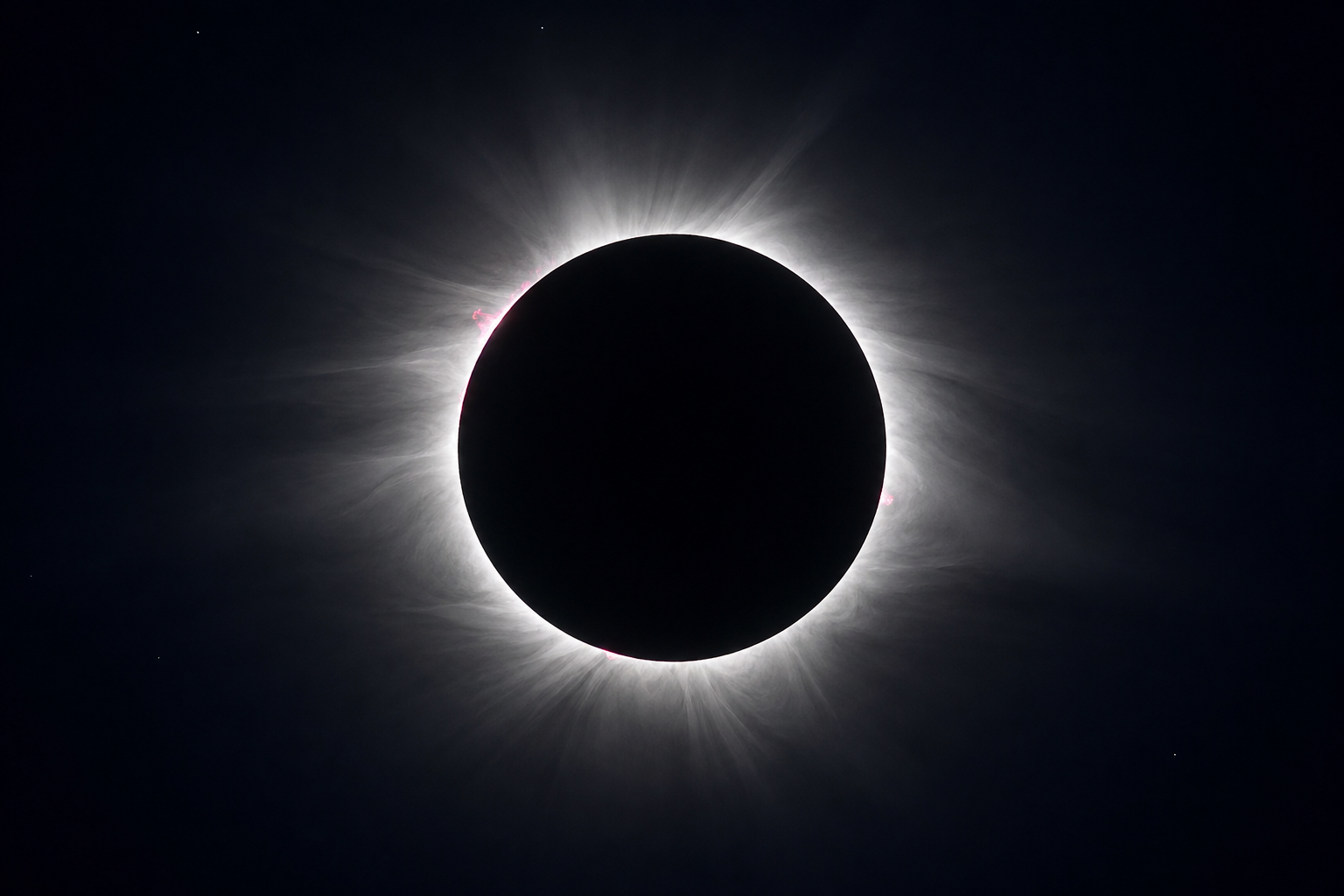
Spain is getting ready to experience one of the most eagerly anticipated astronomical phenomena of recent years. On 12 August 2026, there will be a total solar eclipse, a particularly important event as it will be the first total solar eclipse visible from the Iberian Peninsula in more than a century.
For a few minutes, the Moon will move between the Earth and the Sun, completely covering the solar disc from certain parts of the country. The sky will darken at sunset, allowing us to enjoy one of the most spectacular natural phenomena.
But where will it be visible? Which cities will be inside the franja de totalidad? And what better way to make the most of this occasion than by travelling around Spain and discovering new places while practising Spanish?
When will the 2026 solar eclipse take place?
The eclipse will take place on Wednesday, 12 August 2026, during the late afternoon.
Although it will be visible as a partial eclipse from practically all of Spain, only certain areas will be inside the franja de totalidad. In these areas, the Moon will completely cover the Sun for a short period of time.
The franja de totalidad will cross Spain from west to east, passing through different autonomous communities from Galicia to the Balearic Islands. Among the cities that will experience the total eclipse are A Coruña, Oviedo, León, Bilbao, Zaragoza and València, among others.
The eclipse will also have a special characteristic: the Sun will be very close to the horizon. Therefore, if you want to enjoy it to the fullest, it will be essential to find a place with a clear view towards the west, without buildings, trees or mountains blocking the sky.
Where to see the total eclipse in Spain?
The franja de totalidad will cross the north of the Peninsula before continuing eastwards, passing through different Spanish landscapes and cities.
A Coruña and Galicia
Galicia will be one of the first areas of Spain to experience the total eclipse. A Coruña and other Galician towns will be inside the franja de totalidad, making the Atlantic coast a privileged setting for observing the phenomenon.
If you also have the opportunity to travel around Galicia, you can combine the eclipse with some of the region’s main attractions: its landscapes, historic cities and gastronomy.
Asturias and Cantabria
Asturias will be another of the main protagonists of the eclipse. Cities such as Oviedo and Gijón will be inside the franja de totalidad.
Northern Spain also offers the perfect combination for anyone looking to turn eclipse viewing into a short getaway. Nature, beaches, gastronomy and historic cities make this area an ideal destination for discovering another side of Spain.
Castilla y León, the Basque Country and Navarre
The franja will continue eastwards, crossing different areas of Castilla y León, the Basque Country and Navarre.
León and Bilbao will be among the cities from which you will be able to experience la totalidad. For lovers of culture and history, this can be an excellent opportunity to discover some of the most interesting cities in northern Spain.
Aragón and the Valencian Community
The eclipse will continue its journey eastwards through Aragón and the Valencian Community. Zaragoza and València are among the regional capitals that will be able to enjoy la totalidad.
In Valencia, you can also combine the astronomical phenomenon with some of the city’s main attractions: the Mediterranean, the City of Arts and Sciences, the Central Market and its gastronomy.
The Balearic Islands
The franja de totalidad will eventually reach the Balearic Islands, where the total eclipse will also be visible.
The islands offer a particularly attractive setting for watching the sky at sunset, although it will once again be important to find a location with good visibility towards the west.
What if you are in Seville or Málaga?
If you are studying Spanish in Seville or Málaga, you will have to travel if you want to experience la fase de totalidad of the 2026 eclipse.
From Andalusia, the eclipse will be visible, but not as a total eclipse. This can be a great excuse to discover other parts of Spain and turn an astronomical event into a cultural experience.
Because one of the best things about studying Spanish in Spain is precisely this: you don’t have to limit yourself to the classroom. You can learn Spanish in Seville, travel to Asturias to see an eclipse, discover a new city and come back with many more words and experiences than you had when you started.
The eclipse as an opportunity to learn Spanish
A trip to see the eclipse can also be a fun way to put your Spanish into practice.
During these days, you will have the opportunity to learn words related to astronomy and use them in real conversations:
Eclipse, Sol, Luna, cielo, atardecer, oscuridad, luz, horizonte, observar and totalidad are just some of the terms you can add to your vocabulary.
You can also learn some expressions that you will probably hear while waiting for the eclipse:
“¿A qué hora empieza?”
“¿Desde dónde se ve mejor?”
“¿Cuánto dura?”
“El cielo se está oscureciendo.”
“¡Qué espectáculo!”
Learning a language also means learning how to navigate everyday situations, talk to other people and discover new ways of expressing yourself. And there are few better experiences for doing this than travelling.
Travel around Spain while learning Spanish
At Carlos V Education, we believe that learning Spanish is about much more than studying grammar and vocabulary.
Spain offers the perfect environment for combining language learning with a cultural experience. From Seville and Málaga to Madrid and other destinations, every city offers a different way of living, speaking and enjoying Spanish.
The 2026 solar eclipse is a perfect example of this. An astronomical event can become an opportunity to travel, discover new places, practise the language and share a unique experience with people from different countries.
If you are thinking about studying Spanish in Spain, perhaps this is the perfect excuse to start planning your next adventure.
Learn Spanish, discover Spain and live experiences you will remember forever.
Observe the eclipse safely
It is very important to remember that you should never look directly at the Sun during the partial phases of the eclipse without appropriate protection. To observe it safely, you must use approved eclipse glasses or solar filters and follow the recommendations of the relevant authorities and specialist organisations. The Instituto Geográfico Nacional provides detailed information and a viewer that allows you to check how the eclipse will look from each location.